RVBench
Benchmarking Hybrid Relational-Vector Database Systems.
Get started View workload GitHub
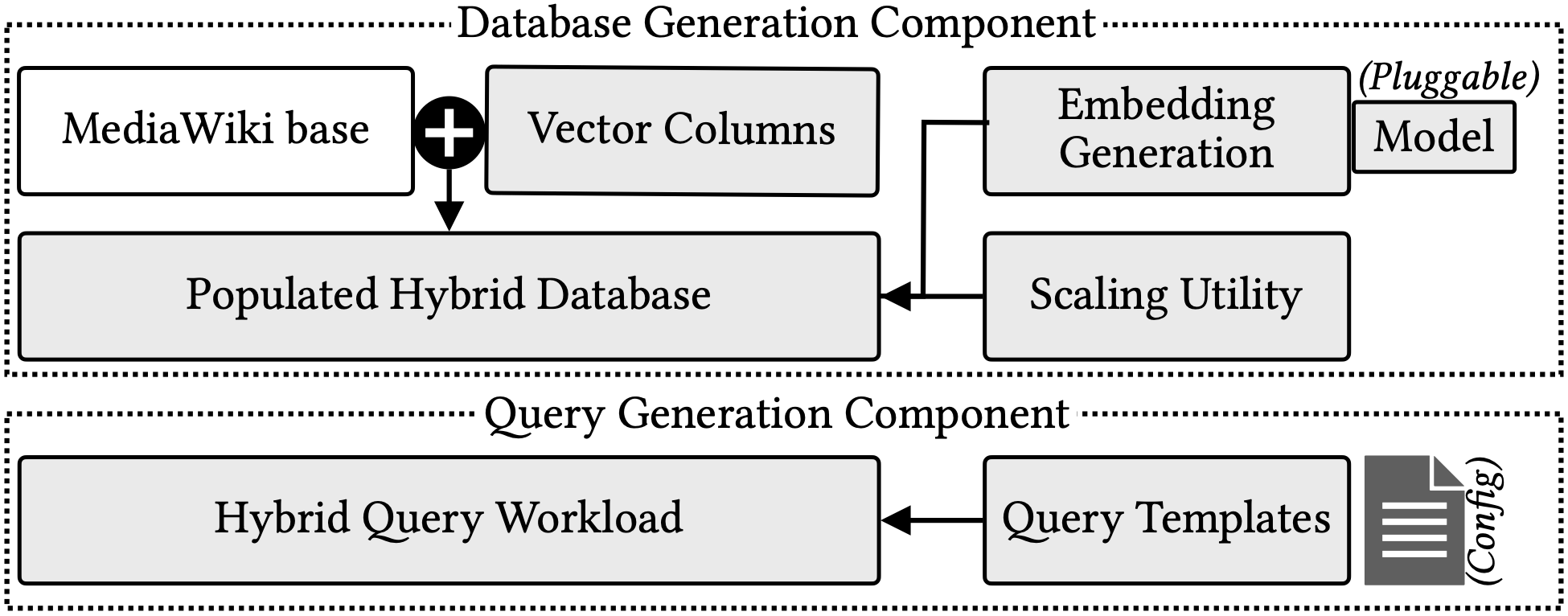
What RVBench evaluates
RVBench evaluates databases that combine relational operators with vector similarity search in the same analytical workload. It is designed for database and vector-search researchers who want to test planner behavior, index selection, latency, and retrieval quality for realistic hybrid workloads.
RVBench goes beyond simple filter-plus-vector-search queries. It includes top-k nearest-neighbor workloads, rank-interval workloads, and sampled-neighbor workloads, combined with SQL constructs such as joins, filters, grouping, aggregation, CTEs, subqueries, and set operations.
Why it matters
AI-powered systems often need both semantic search and structured reasoning. A user may ask for pages similar to a query, but only within a date range, category, author group, or metadata predicate. RVBench makes these patterns concrete and reproducible.
Key features
| Capability | Description |
|---|---|
| MediaWiki-derived schema | Uses Page, Text, Revision, and CategoryLinks tables with vector embeddings. |
| 39 query templates | Covers nearest-neighbor, interval-neighbor, and sampled-neighbor workloads. |
| Pluggable embeddings | Supports transformer-based embedding generation and custom model integration. |
| Scalable datasets | Supports sampling and scale-factor based evaluation. |
| Reference implementation | Includes C++17 baseline execution with vector index backends. |
| Accuracy tooling | Measures latency plus quality metrics such as precision and RMSE. |
Quick commands
git clone https://github.com/IITD-data-systems/RVBench.git
cd RVBench

cd database-generation
bash database_and_query_generator.sh

cd ../baseline-implementation/queries
bash run.sh

cd ../../output-files
bash accuracy_baseline.sh
Recommended next steps
- Read the getting started guide.
- Review the workload taxonomy.
- Add the citation to your paper if RVBench helps your research.